Saturday, April 1, 2017

My Summary of Special Relativity


As you may know, Einstein’s theory of relativity is actually two related theories.  The Theory of Special Relativity, published in 1905, describes the nature of space and time for the special case of inertial reference frames (coordinate systems that aren’t accelerating relative to each other and have no gravity).  The Theory of General Relativity, published ten agonizing years later, covers the more general case of accelerating reference frames, which Einstein asserted are the same as gravity.  The math involved in general relativity is much more advanced, but special relativity is where most of the counter-intuitive weirdness comes from.  This essay covers special relativity (SR).


A reference frame is a construct we use to describe a set of locations in the universe that are rigidly connected so they move together at the same speed.  Such constructs are useful because we can draw imaginary coordinate axes on them and thereby apply all the tools of mathematics to study events that happen in the frame.  Obviously, not everything in the universe is rigidly connected to everything else, and things move at different speeds.  Therefore, we’ll need many different reference frames to accurately describe the universe.  


Imagine you’re in the back of a pickup truck driving at a constant speed down a straight road, and your friend is standing on the sidewalk as you drive by.  As you and your friend wave to each other, you are in inertial reference frames that are moving relative to each other at a constant velocity, based on the speed and direction of the truck relative to the sidewalk.  When the relative velocity is constant, we say the motion of the reference frames is inertial (since the law of inertia says objects will travel in this way if no forces act on them).


It’s been know for hundreds of years that this kind of relative motion exposed deep laws of physics.  For example, if you reached out your hand and gave a high five to your friend on the sidewalk, both of you would feel the slap with equal force.  You could say your friend on the sidewalk is at rest while you and the truck are moving, but this is an arbitrary designation.  This can only be said if you affix the coordinate axes to the sidewalk.  If you fix the coordinate axes to the truck, then it’s you who’s at rest and your friend on the sidewalk who is moving relative to the coordinate axes or reference frame.  This thought experiment points out that the notion of absolute rest and motion that Newton championed is not as useful as the notion of relative rest and motion.  After all, both truck and sidewalk are on the rotating and orbiting Earth, which is in the solar system which orbits the galaxy, etc., but none of these other motions make any difference in how the participants in these experiments perceive each other.  


This simplest form of relativity is known as “Galilean relativity”, because Galileo Galilei was the first to state it clearly.  His most famous postulate of relativity is that if you were inside a windowless cabin on a ship on a clam lake, there is no experiment you could do that would tell you if the ship was at rest (relative to the lake) or moving in a straight line at a constant speed.  As soon as the ship accelerated or turned, you could feel it immediately.  We’ll come back to that when we talk about gravity, but for inertial reference frames, inertial (constant-speed straight-line) motion can’t be detected.


With Galilean relativity, velocities add up in simple ways.  This is immediately intuitive.  Imagine you’re in the back of the pickup truck with a paintball gun, preparing to prank your friend on the sidewalk.  If the truck is going 20 mph and the paintball gun shoots at 30 mph, then if your aim is true, your friend on the sidewalk will feel as if the paintball has hit him at 50 mph, because that’s its speed relative to the sidewalk.  The velocity of the paintball from the gun is added to the velocity of the truck and gun.  


This intuitive picture seemed to work, and Newton’s laws of mechanics are based on it.  The triumph of the theory of special relativity is to recognize that this isn’t quite right; it’s only an approximation.  At low speeds, it’s a very good approximation, so how was the inaccuracy discovered?  The answer involves the speed of light.


By the end of the 19th century, the speed of light was known to be finite and had been measured to some degree of accuracy.  The physicists of the day assumed that everything, including light, obeyed the principle of Galilean relativity.  Given this assumption, light had to be moving relative to something, and they gave this something the name “luminiferous ether”.  The ether was taken to be the substance which filled and defined a “universal rest” reference frame, relative to which everything else could be measured.  


Many experiments were done to try to measure the speed of the earth relative to the ether.  The first experiment that was done well enough to be trusted by the bulk of the physics community was by Albert Michelson and Edward Morely.  The Michelson-Morley experiment used an interferometer, the same instrument used in the recent LIGO apparatus that detected gravitational waves.  An interferometer uses light sent down two perpendicular arms that reflect it back to the right angle vertex.  This is generally done with a partially reflective mirror oriented at 45 degrees to a light source.  The mirror “splits” the light so that some is reflected and goes down one arm and some is transmitted and goes down the other arm.  When these partial beams are reflected back to the mirror, the two beams are partially reflected and partially transmitted again.  This combines light from both arms of the interferometer and sends the combined signal to a detector.  See this animation on Wikipedia (just the left hand side of the diagram for now).  


The lengths of the arms can be calibrated so the light that travelled on the two arms is in anti-phase when it reaches the detector.  This means all the crests of one light wave line up exactly with the troughs of the other light wave so they completely cancel each other out and the detector sees nothing.  After such a calibration, if a subsequent change in experimental conditions causes the light to take longer to travel one arm versus the other, then the light won’t be perfectly in anti-phase anymore, and the destructive interference will be incomplete.  Then the detector sees a signal, and the amount of signal can be used to measure the difference in time taken by the light that traveled the different arms.  


Michelson and Morley expected to be able to see a difference in the time taken by the two light beams when they changed the orientation of their interferometer.  In a sense, they were searching for the ether, the reference of absolute rest.  They expected that when one arm was oriented parallel to the direction of Earth’s motion relative to the ether, the path light would have to travel on this arm would be slightly longer than the light that took the path perpendicular to the apparatus’ motion relative to the ether.  See this analysis to understand why, but it’s just basic Euclidean geometry, algebra, and the assumption of Galilean relativity.  Or just look at the right side of the Wikipedia animation to get an intuitive feel for why the travel times were expected be different, resulting in a phase shift of the light beams.


The Michelson-Morley experiment is said to be the most famous and consequential “failed” experiment of all time.  Of course “failed” is the wrong word.  The experiment produced a “negative” result, meaning it didn’t show the expected signal from the expected path length differences of the two arms of the interferometer.  This negative result was a major anomaly demanding an explanation, since it contradicted the prevailing theory of a stationary ether and Galilean relativity.  And as all good anomalies do, this one spawned a scientific revolution.


If there truly was no way to measure motion relative to a fixed ether, this had immediate logical and mathematical consequences.  It was not Einstein, but several other physicists of the late 19th century who worked out these implications.  Hendrik Lorentz got a lot of the credit, and the transformations used in special relativity still bear his name.  Einstein’s major contribution was to show that the Lorentz transformations relating the velocities of relatively moving reference frames were a consequence of only two principles, and didn’t require the existence of an ether or a frame of absolute rest.  The two principles from which SR is derived are:


  1. The laws of physics have the same form in all frames of reference.
  2. The speed of light is the same for all observers in all frames of reference.


The first principle is an axiom, taken as given without proof.  Most people don’t have a lot of trouble accepting it, but the second principle is a bit more counter-intuitive.  It basically says that Galilean relativity is false.  It doesn’t have to be taken on faith, since that’s what you get if you believe the results of the Michelson-Morley experiment are correct.  They observed that light travelled the same speed no matter how they oriented their apparatus relative to the orbital motion of the earth.  People didn't notice the departure from Galilean relativity until the late 19th century because it only becomes significant for things traveling near the speed of light.  The value of the speed of light, c (approximately 3 x 10^8 m/s or 186,000 mi/s), also falls out of Maxwell’s Equations of electromagnetism, which led Maxwell to propose that light was an electromagnetic wave.


The Lorentz transformation is simply a set of formulas that allow you to convert distances and time in one reference frame to these same quantities with respect to another reference frame that’s moving inertially relative to the first.  When making up such formulas, it’s convenient to pick our coordinate systems so that the relative motion only occurs in the x-axis direction.  In that case, Galilean relativity has a simple transformation:
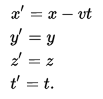

where x, y, and z are the coordinates in the “first” reference frame (which we’re choosing to call “at rest”), the primed coordinates are the “moving” reference frame, and v is the relative speed of the reference frames.  This is the transformation used in the example above to determine that the speed of the pickup truck and the paintball should be added together to determine what speed your friend on the sidewalk perceives (the minus sign could be a plus sign, depending on how you choose your coordinates).  


The Lorentz transformation is a little more complicated:
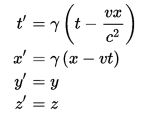

 where


The gamma factor is simpler than it looks.  If your speed is much less than c (the speed of light), then the second term under the radical () is very close to zero.  When that happens, gamma is very close to 1, and the Lorentz transformation approximately reduces to the Galilean transformation.  (This is why Galilean relativity seemed right for so long).  On the other hand, if your speed is very close to c, then the value of gamma skyrockets.  Here are some sample values:
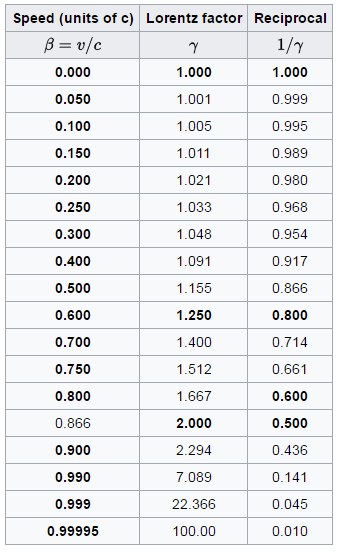


The most surprising thing about the Lorentz transformation is that the x coordinate isn’t the only one affected by relative motion in the x direction.  The time coordinate is also affected.  This makes a little more sense when you realize the whole purpose of creating the transformation in the first place was to make the speed of light constant in all reference frames.  Since speed is distance/time, of course time must be affected in order to keep the distance/time ratio constant.


This mixing of space and time is what gives SR some of its truly weird and counterintuitive properties.  I don’t know if people can get used to it, but I haven’t yet.  If you plot the x and t coordinates (omitting y and z since they’re not interesting and we run out of dimensions to draw them in) along with the primed x and t coordinates, we get this remarkable plot:


Notice how the primed axes no longer appear to be at right angles to each other.  However, this is only because we’ve drawn the graph from the perspective of the unprimed coordinates.  Unexpectedly, if we adopted the other perspective, the primed axes would look “normal” and the unprimed axes would appear in exactly the same positions as the primed axes shown above.  This illustrates the counterintuitive reciprocal nature of the time and length dilation effects.  


For any “event” that occurs on this “spacetime” graph, the two different coordinate systems will ascribe different relative amounts of space vs. time to the event.  The rectangle and parallelogram on the diagram are meant to represent “dropping a perpendicular” to each coordinate axis in order to measure an event’s position and time.  Notice the different amounts of time and space ascribed by the two coordinate systems to the event at the upper right corner of the rectangle and parallelogram (compared to another imagined event at the shared origin).


The only things that are unchanged in both coordinate systems are the 45 degree x = t and x = -t lines.  These represent light rays travelling in the positive and negative x directions.  (The units have been chosen so that the speed of light is equal to 1).  Again, this shouldn’t be surprising since the whole purpose of all of this is to construct an analytic framework where the speed of light is constant in all inertial reference frames.  


Newtonian physics and Galilean relativity don’t rotate space and time into each other like this.  Newton never had the need to add a time axis to his motion diagrams because he assumed there was one absolute reference of time, and that it was possible to consider “all points in space at a given time”.  This is simply not possible when it’s a different time at different points in space that are moving relative to one another.  In SR, clock readings can only be made locally.  We normally make assumptions about what distant clocks read, but these assumptions are invalid.  As long as you insist on thinking of space and time separately, as if there existed “all of space at a given time” then SR will seem bizarre and paradoxical.  Well, there is no unique time for all of space.  Doesn’t exist.  You were misinformed.  Get over it.


The easiest way to start to accept that there is no absolute universal time is to understand the relativity of simultaneity.  That is, whether or not two events are simultaneous depends on how you’re moving relative to the events.  All other times reduce to this, since you’re always comparing one event of interest to another event (the tick of a clock).    If you believe the tilted coordinate axes described above, then this animation from Wikipedia should convince you that events can be simultaneous in one reference frame, non-simultaneous in another, and non-simultaneous in the opposite order in yet a third reference frame (the white bar represents the progression of time in the reference frames).  If you aren’t on board with the tilted axes, then try this video.  


How can events occur in different orders depending on who’s watching?  Doesn’t that potentially mix up the order of cause and effect?  No, because the order of events can only change for events with spacelike separation.   To understand what this means, you need to imagine that every event has a “light cone” that precedes and follows it.  The surface of the cone represents the possible paths light rays can take.  As shown below, this is a spacetime diagram where units are again chosen so the speed of light is 1 (it plots at 45 degrees), the vertical axis is time, and only two spatial dimensions are shown.


If one event is caused by another, then the effect event must be inside the light cone of the cause event, since some some signal or piece of matter must pass between them for them to be causally related, and nothing can travel faster than the speed of light.  Events with spacelike separation do not have light cones that overlap, so they are said to be causally disconnected.  For causally connected events, all observers will agree on the order of events, so causality is saved.  The diagram below shows several light cones that can be imagined to represent causally connected and causally disconnected events.  Only a timelike path can connect causally related events.


The ultimate effect of the Lorentz transformation is that relatively moving observers disagree about both time and distance.  This leads to the fact that moving observers experience both time dilation and length contraction.  Time dilation as derived from the Lorentz transformation is expressed with this formula relating the difference in time (𝝙t) between two events in primed and unprimed coordinate systems:


In this formula, the closer v gets to c, the smaller the quantity under the radical becomes, and the larger the primed 𝝙t becomes compared to the unprimed 𝝙t.  This means if you’re moving relative to a clock, the clock will appear to be running slowly, since your 𝝙t is larger than the 𝝙t in the clock’s reference frame.  However, in the clock’s reference frame, it appears to be running normally.   This result has been verified by flying atomic clocks around on planes and then later comparing them to ground-based clocks.  Taking this to the extreme, if you could actually travel at the speed of light, a clock at rest would appear to be standing still.  


The Lorentz transformation can be used to derive the following formula for length contraction of an object as seen from a reference frame moving relative to that object:
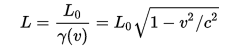


where L0 is the length of the object in the reference frame where it is at rest, v is the relative speed of the two reference frames, and 𝛾(v) is shown in expanded form on the right.  This formula shows that if the relative motion is much slower than the speed of light, the length is nearly the same in both reference frames.  As the relative speed approaches c, the length of the object as seen from the moving reference frame approaches zero.


Is there anything that stays the same in every inertial reference frame?  As a matter of fact, there is.  If you combine the space and time separation (deltas) between two events using the formula below, you get the quantity on the left hand side, which is called the “spacetime interval”:



The wonderful thing about the spacetime interval is that it’s invariant, meaning it won’t change when you view the two events from a different reference frame that’s moving inertially with respect to the first.  The two reference frames may see different amounts of space vs. time, but the spacetime interval will always be the same.


An even more remarkable takeaway from this formula is that c is essentially used as a conversion factor between time and space.  The remarkable thing is not that electromagnetic radiation is observed to move at this speed, but that such a fixed conversion factor exists at all.  


This conversion factor between time and space also leads to the last thing I’ll say in this essay on special relativity.  The fact is, everything, including you, is always travelling through spacetime at the speed of light.  If you are sitting still in your reference frame, then all of your spacetime travel is along your time axis, and you’re travelling on that axis at the speed of light, as the spacetime interval formula indicates.  As soon as you start travelling in space, then some of your velocity is used up by this travel, and your progress through time must be less than c (as seen from your former rest frame).  This is one way to look at time dilation (your clock will be seen as running slow by an observer you left behind).


What does this say about light itself?  The time dilation formula:


isn’t very helpful.  If you imagine a photon that left a distant star a billion years ago and entered your eye just now, then in your unprimed coordinates, 𝝙t is one billion years.  The reference frame of the photon is moving at c, so the denominator in the formula is zero.  This prevents us from calculating 𝝙t'.  No matter what 𝝙t is (no matter how far away the star is), the result is the same.

This says that light is expending all of its velocity on travel through space, so there’s no velocity left for travel through time.  This seems to indicate that time does not pass at all for a photon.  You could try to say that 𝝙t' for the photon is infinity, or zero, but neither one really works.  There is an incredible variety of answers to this question on the Internet, and most of them are pretty incoherent.  If you ever get a chance to talk to a photon and ask it what happened on its trip, please let me know.

Saturday, February 27, 2016

9/11 - Negotiation = Trump


When I was growing up in the 60's and 70's, airport security was nonexistent by today's standards, and planes getting hijacked was a thing that happened from time to time, like school shootings today.  In those days, some of the hijackings were political, but many were just done for money.  Commandeering a plane was just a way to acquire a bunch of hostages whose lives could be traded for cash.  This rarely worked out for the hijackers, whose plane would often be taken away from them by force, even if innocent lives were inevitably lost along the way.

These hijack-for-profit extortionists would kill hostages if necessary to gain tactical advantage, but murder didn't seem to be their primary goal.  So I thought the authorities should just pay the ransom to ensure the safe release of all the innocents.  It had to be explained to me why this seemingly obvious strategy was a naive idea.  The way it went was that if we give in to their demands, this will only encourage other groups to copy the same strategy, resulting in even more hijackings in the future.

Even this meager reasoning has been lost in today's rhetoric on terrorism.  Leaders from all countries and of all political persuasions just flatly state: "we don't negotiate with terrorists".  Why is this policy never examined?  In the hostages-for-cash scenario, there is a certain grim logic to the reasoning, but does the same calculus necessarily apply to today's political terrorism?

You might think the same logic applies universally, but a deeper analysis shows otherwise.  True, if political groups got what they wanted, their tactics might become more popular in the future.  But what do they want?  Would the demands of all similar groups be insatiable, growing without bound until the whole world was engulfed in perpetual terror?

If you only consume mainstream news, you wouldn't even know they had any demands, let alone what they are.  Terrorist groups like Al Qaeda, ISIS and the like are depicted as mindless sub-humans, bent on a completely irrational path of destroying us Westerners, who are just minding our own business when they strike out at us.  Within this narrative, the only acceptable response is to annihilate them with superior violence.

This characterization of today's terrorists is false.  They are human beings, trying to build a society just like us.  They have very specific demands of us, many of which are quite reasonable.  Meeting their demands would inevitably involve a reduction in western violence in their lands, which would cool the anger that's directed back at us.  Therefore, negotiation and willingness to meet some of their demands would result in a de-esalation of violence.

How did I come by such a contrary viewpoint?  Is it hopelessly naive?  A turning point for me was reading the book Imperial Hubris.  Unless you read a source like this, you and I can't have a rational discussion about things, because you're wallowing in ignorance.  Did you know that Al Qaeda articulated a very short, very specific list of demands, years before 9/11?  Why was this not widely reported, especially after 9/11 resulted from our failure to meet their demands?  Because the unconditional, unexamined "we don't negotiate with terrorists" mantra makes such thoughts unthinkable, let alone admissible in public debate.

If we at least entertain the possibility that people acting with violence are rational human beings who are simply out of options, then ending the cycle of violence becomes possible.  Why is this unthinkable?  The United States acts with violence, yet most Americans consider this rational, just and necessary action.  Why isn't the "enemy" given the same benefit of the doubt?  Answer: because they've been dehumanized so we don't need to consider their concerns.

What are the demands Al Qaeda made prior to 9/11?  Things like 1) Stop militarily occupying Muslim holy lands, 2) Stop propping up corrupt dictators in the Arab world, and 3) Stop blind support of Israel and dehumanization of the Palestinians.  Are such demands really beyond the pale, not even worthy of discussion?  To the US political and media elite, they apparently are, but what do you think?  Read Imperial Hubris and decide for yourself how bad the bad guys really are.

How does Donald Trump fit into this story?  I'll argue that someone like him is inevitable when a refusal to negotiate with others is the universal stance on both sides of the political divide in America.  Through eight years of Bush and eight years of Obama, the narrative pushed by both parties and their allied media has been the dehumanization of Muslim enemies, and a refusal to even admit they could have legitimate grievances with us.  When was the last time you saw a media interview of someone from a group branded as terrorist by the US?  Obama can talk about how we're at war with the Terrorists(TM), not Islam, but this doesn't help.  If Obama is such a nuanced, thoughtful statesman, why can't he admit the terrorists themselves are also human beings?

When superior violence is the only acceptable response to terrorism, escalation is inevitable, as the history of the War on Terror has shown.  If a genuinely peace-minded leader emerged and tried to negotiate with terrorists, the media would crucify him.  Opponents would call him a terrorist-lover, and the media would repeat this without challenge.  Authoritarianism through superior violence saturates our culture, from school to policing to war.  In such an atmosphere, one begins to wonder why it took so long for a Trump to appear.  And the media look around in horror, wondering how this could have happened, never considering their role in making it inevitable.

Did you know that Al Qaeda's threat, if their demands weren't met, was to draw us into an endless, global war that would bankrupt us?  That gives you a different take on 9/11 and the War on Terror, doesn't it?

How can we get out of this mess?  Start making negotiation a regular part of foreign policy discussions.  Remember when diplomacy used to be a respected role?  Today, diplomats only role is to convey threats of violence in euphemistic language.  The media can change this by simply asking questions.  Why has the so-called terrorist group done this horrifying act?  What do they hope to gain?  Why do they hate us?  Are their demands reasonable or not?  These questions have answers, but we never hear them because journalists and public officials never ask.  You can start by asking them yourself.

Saturday, January 2, 2016

My Summary of Quantum Mechanics


As some of you know, I have an interest in physics.  I’ve been reading “popular” books for many years, marveling at the strangeness of our universe.  Eventually I became frustrated with popular accounts, where authors interpret the math and experimental results for us.  It seemed to me that many authors were in love with complexity and paradox.  They said the math was just that way, indeed the universe was just that way.  I doubt the universe is fundamentally paradoxical, and I decided I could no longer take their word for it.  I decided to learn physics for real, with the math.  


As an electrical engineering major, I took a full series of calculus and a couple of physics courses.  I thought I could rely on this background and just jump into a mathematical treatment of quantum mechanics, which seemed the richest source of paradox.  I shortly had to admit that after 30 years, calculus can be utterly and completely forgotten.  Plus, I had never completed linear algebra.  Undaunted, I started a thorough math review that included calculus, some pre-calc concepts, and linear algebra.  This was done mostly on Coursera and Khan Academy.  


After this prep, I still could not penetrate the two QM books I had in my possession, and I became depressed.  Then it occurred to me to ask the Internet if there was a better book.  The Internet delivered, in the form of a recommendation for David J. Griffiths’ book Introduction to Quantum Mechanics.  This book made all the difference for me.  It’s crystal clear, and builds up the concepts in a logical way that other books don’t for some reason.  He even includes an appendix that teaches you the specialized linear algebra concepts you need to know.  I read the first three chapters quite closely, but mostly skipped the problems and skimmed many of the later chapters that went over complex calculations that didn’t interest me.


So, what does the theory of Quantum Mechanics tell us?  What does the math look like?  Other books had given me the impression that QM was based on linear algebra, but this isn’t really true.  It’s based firmly on calculus, like other parts of physics.  In this respect, I think it’s misleading to say that QM is somehow “discrete”.  It’s true that things like the energy levels in atoms are calculated as a set of discrete values, and yes, linear algebra is used in these calculations, but these solutions come ultimately from equations of good old fashioned continuous variables.  This is especially true of Schrodinger’s Wave Mechanics formulation, but seems equally true in Heisenberg’s Matrix Mechanics formulation, where matrix elements are computed as Fourier coefficients of functions of continuous variables.


The foundation of quantum (wave) mechanics is the wave function, denoted by the Greek letter psi.  The wave function is a function of four continuous variables (time and three spatial variables), and represents the state of the system being examined.  Thus, each system has a different wave function, just as each system has a different equation of motion in classical mechanics.  In both schemes, the time evolution of the system’s state function is governed by a differential equation.  In classical mechanics, it’s Newton’s laws, i.e., F = ma (which is a differential equation since a is the second derivative of position).  In QM, the time evolution of the system’s state is governed by the Schrodinger Equation.  This differential equation is complicated enough if you pretend space has only one dimension (x), so that’s how it’s normally introduced.


Here i is the imaginary unit, h is Plank's constant, m is the (non-relativistic) mass of the system (i.e., particle), Psi is the wave function, V is the potential affecting the particle, and H is the Hamiltonian. a representation of the total energy of the system.


A “solution” of a differential equation is any function that varies in the required way that the differential equation is satisfied.  Now, partial differential equations are notoriously hard to find solutions for, and the time-dependent Schrodinger equation above contains differentials of Psi with respect to both position and time.  So as a practical matter, the equation is separated into a time-dependent part and position-dependent part.  This results in a simpler equation called the time-independent Schrodinger Equation, whose solutions are the so-called “stationary states” (because they don’t evolve in time).  


It turns out that the solutions to the general (time-dependent) Schrodinger Equation can always be expressed as linear combinations of the stationary states.  It’s these linear combinations that account for one of the oft-cited mysterious features of QM, superposition.  When the state of the system is a combination of sub-states, people say that the sub-states are superposed, i.e., simultaneously true to some fractional degree.  


When a system’s state is measured, only one of the sub-states is found, but more on this later.  In this way, measurements become one of the other mysterious features of QM.  What people say is that the system’s state (i.e, wave function) was in a superposition (e.g, linear combination of sub-states) before measurement, and that the act of measurement “collapses” the wave function to only one of the sub-states.  Mathematically, this happens because the result of a measurement is calculated by multiplying a particular matrix by a vector representation of the state, Psi.  So in this case, the elements of the vector are actually functions (the stationary state solutions to the time-independent Schrodinger Equation).  So this is where the linear algebra comes in, but the vector space is an infinite-dimensional space of orthogonal wave functions .  The functions and matrices are rather special, so it always turns out that the wave functions are eigenvectors of the measurement matrix.  An eigenvector of a matrix is a vector that comes out merely scaled (rather than, say, rotated or otherwise distorted) when multiplied by the matrix.  The scaling factor is called the eigenvalue, and in general is different for each eigenvector and matrix.  Each type of measurement, e.g., position, momentum, or energy, is represented by a different matrix, usually called an operator.


That’s the gist of it.  Doing physics involves defining a system with some initial conditions, solving the Schrodinger Equation, and then computing the different eigenvalues that may be returned by a measurement.  However, the theory cannot say which eigenfunction/eigenvalue pair may be selected by a given measurement.  It could be any of the component wave functions in the system’s superposed state.  The theory can say only the probability of selecting a certain component out of the superposition, which equals the square of the coefficient each component has in relation to the other components in the superposition.  For this statistical interpretation to make sense, the wave function must satisfy the property that the sum of all probabilities is 1, i.e.,


This requirement not only means that all acceptable wave functions must be “square integrable”, but also that they typically must be “normalized”, which means multiplying then by some factor that makes the integral above equal 1, rather than whatever it equaled when you chose the wave function.  This strikes me as a massive hack, albeit a hack that works.  Wave functions are guessed and normalized (i.e., fudged) so that they fit into the statistical interpretation of measurements of the wave function state.  The normalization requirement also rests on the assumption that the probabilities sum to 1 because “the particle must be found somewhere”, (or found with some energy, if that’s what’s being measured).  All of this is not derived from some physical principle or logical necessity.  It’s all just cobbled together into a system that happens to be useful for measuring the things we know how to measure.


This statistical interpretation of the measurement operation is perhaps the most frustrating part of QM for me and many others.  It certainly seems to be the jumping off point for how to interpret the theory, which is my main interest.  What struck me in my study is how ad-hoc the whole scheme is, and how far divorced from physical reality the math is.  In classical mechanics, a particle “really has” the properties represented by the quantities in the equations, and if you make a measurement, you get the instantaneous value of one of the variables.  I believe, along with Einstein, that a proper atomic theory should be the same way.


The statistical interpretation of QM is also the source of the famous “uncertainty principle”.  Many authors speak, wrongly, as if the uncertainty principle applies to a single particle, saying that the more precisely a particle’s position is known, the less precisely its momentum can be known.  (There are other pairs of complementary properties also).  This is not at all what the uncertainty principle says.  Being part of the statistical interpretation, the uncertainty principle states that the product of the standard deviations of two complementary observables has a lower limit:


That’s standard deviations, as in the statistical properties of repeated measurements.  Thus, the principle says nothing about the “actual” properties of a single particle, but only about the statistical character of repeated experiments done on multiple particles that start in the same state.  


Now it isn’t quite fair to compare quantum measurements with classical measurements.  For classical measurements, you can generally devise a measurement apparatus that doesn’t significantly disrupt the phenomenon being measured.  Not so for quantum phenomena at the atomic level.  You can’t just “look at” an electron to see where it is.  Shining even a single photon onto the electron will invariably alter the electron’s state in a large way.  But this is the only way we know how to do measurements.    


I believe the limitation of statistical predictions is a shortcoming of QM theory and our disruptive experimental techniques.  It’s hard to imagine other experimental techniques, but I believe there is some underlying reality that’s described deterministically by a theory beyond quantum mechanics.  Many others follow Bohr in insisting that the theory is complete and that our universe “really is” statistical in nature, composed of superpositions, etc. I don’t see any basis for such an interpretation.  In my view, QM is simply a limited calculation tool.  People make all sorts of assumptions about how particles exist in certain states and how wave functions collapse, when in fact these are just assumptions, not facts.  Many equations and experimental results are wildly over-interpreted beyond what they actually reveal.  We have no idea yet what “really exists” at the atomic level.  We have some operational theories that give good predictions for some experiments, but I don’t think we can say what nature really “is”.  


My future studies of QM will delve into what exactly is a “measurement”.  How does the apparatus work?  Why are they so destructive?  Some people believe that the wave function collapse is not a real phenomena, but simply an apparent one that is a result of the system under study becoming entangled with the measurement apparatus so that the system’s wave function experiences “decoherence”.  When I find out what that means, I’ll let you know,

Saturday, June 15, 2013

Why Your Opinion on NSA Snooping Is Irrelevant


Much of the discussion about the recent revelations of the NSA's massive snooping capabilities has centered around whether or not people think it's a problem.  There are plenty of opinions, from "The government are fascists trying to kill us", to "I don't care if the government reads my stupid emails", to "It keeps us safe".  The ever-popular "You have nothing to fear if you have nothing to hide" always gets discussed, whether this opinion is being advocated or debunked.  But all of these opinions, including yours and mine, are completely irrelevant to what's going on here.

The emphasis on opinions and polling data is powered by a persistent, pervasive and false belief that the United States is and should be a democracy.  In a democracy, every citizen gets to vote on every issue, and the majority rules.  This is not the form of government we have, and it's not the form of government you want.  Other names for majority rule are "mob rule" and "tyranny of the majority".  If majority opinion ruled, women and black people would still be property, and the country would be a Christian police state where homosexuals and atheists were publicly executed.  Is that what you want?  Thankfully, the United States is a representative republic, where the rights of minorities are explicitly protected in the Constitution.  The contrast between democracy and republic is being played out on many issues, most notably gay marriage.  A host of ill-conceived popular votes on gay marriage have elevated the public's bigotry to the status of law, but this will not last.  Legislatures and the courts are slowly but surely seeing that this is a civil rights issue, a matter of equal protection.  The will of the public is going to be overruled by the constitutional government, and this is as it should be.

There are also a lot of people talking about whether the spying programs are legal or not, and there is a lot of misconception about what this means.  The most common misconception is that whenever a piece of legislation is passed by Congress and signed by the president, it becomes legitimate law from there on after unless repealed.  While it's true a signed bill becomes a law, it's really a kind of temporary, provisional law, unless and until it becomes settled law by being tested and upheld in court.  The fact is, much of what has passed through Congress in recent decades is blatantly unconstitutional.  Take, for instance, the NDAA, which authorizes indefinite detention of American citizens without trial.  How can you square this with the Sixth Amendment, which guarantees the right to a speedy public trial?  It's absurd on its face, yet it is, for the moment, law.  People do not seem to understand that the legislature is not obligated to pass laws that agree with the constitution.  They should, but they don't.  And the Supreme Court doesn't have any sort of veto power over legislation.  Ultimately they can strike down legislation, but only after someone brings  a legal case against the government, against the law itself.  This can take years to work its way up to the Supreme Court which can finally overturn the unconstitutional actions of the legislature and executive branch.  We are in that waiting stage for many fundamentally illegitimate laws like the NDAA, which has a major lawsuit against it, currently in the appeal process.

To understand what's so significant about the NSA spying case, you need to appreciate how this lengthy process of interplay between the three branches of government results in settled law, which is the only type of law that has any moral authority.  The key point to realize is that the Bush and Obama administrations have been deliberately and aggressively blocking the process of settling law which ought to involve all three branches of government.  The Washington establishment is pretending that there is oversight and checks and balances because a corrupt warmonger like Sen. Dianne Feinstein says she approved what the executive branch is doing.  But the founders of this country made three branches of  government for a reason.  The judicial branch has been failing very consistently, because they are being swayed by an executive branch which is manipulating the system to prevent the courts from doing their job.  The Obama DOJ is not simply arguing that laws like the NDAA or the NSA's surveillance are constitutional and letting the courts decide.  They are trying to block the cases from being heard, typically by using secrecy claims to prevent the cases from moving forward.  They believe they must do what they're doing in order to protect the country, but they are willing to destroy the country in the process.

These complex, and perhaps boring questions of law are what really matters here, not your opinion of whether or not the NSA's snooping is intrusive or not.  Nor does anybody's security concerns matter here.  Because if we give up our constitutional government, for any reason, we're doomed.  Thousands of years of human history have conclusively demonstrated that unchecked power is inevitably abused.  That's precisely why the founders of the United States set up such an elaborately balanced system of government.  And either we are a nation of laws, or we are a nation of bullies.

Right now, the bullies are in charge.  Whistleblowers who expose wrongdoing are prosecuted, but powerful Washington insiders who lie to Congress are given a pass.  This needs to change if we this country is going to survive in its current form.  If you value the freedom you have left, if you think the United States is a good country worth saving, then you must make your only consideration whether or not the laws are being upheld.  And as defined in our constitution, the making and settling of laws requires all three branches of government.  That's the key result of these recent leaks, exposing what the legislative and executive branches are doing in trying to shut out the judicial branch.  Only if we insist that all of our security laws pass muster in the courts can we preserve our country and our way of life.


Saturday, April 20, 2013

Physics and the Limits of Reductionism


I was recently discussing the difference between chemistry and physics with my 17-year old son, who is thinking about what he wants to study in college.  I said at the time that chemistry studies how protons and electrons behave in atoms, and physics studies what protons and electrons are.  However, soon afterward, I realized that this was wrong.  While this may be an aspiration of physics, it's not true in any practical sense today.  You can take every physics course on earth and nobody will tell you what an electron is, because nobody knows.  The descriptions of reality that physics provides are operational descriptions, meaning they describe how entities operate, or behave, in certain situations.  These descriptions have proven incredibly useful, as demonstrated by our incredible technology, which was designed using these operational understandings.  However, they remain unsatisfying if what you really want are what I'll call existential descriptions, meaning what things really are.  This realization has helped me understand that the reason I study physics is for existential explanations.  I want to know what the heck all this stuff is.

Science typically makes progress through reductionism.  This principle seeks understanding of a complex entity by breaking it down into its constituent parts.  Usually, these parts are simpler than the whole, and once we understand the parts, the behavior of the whole becomes more comprehensible.  The bottom of the reductionist ladder in physics today is called The Standard Model of Particle Physics, which is more or less synonymous with "quantum physics".  Quantum physics is all operational descriptions, for example that things called electrons behave like waves in this experiment and like particles in that experiment.  There may be a layer underneath particle physics that we can't detect today.  String Theory aspires to be this next layer, describing all the particles of the Standard Model as different vibrations of Plank-scale entities called strings.  If string theory is true (which I have strong doubts about, due to Lee Smolin's book The Trouble with Physics), we may be able to eventually detect these strings and come up with satisfying existential descriptions of what they are.

The universe is, of course, not obligated to be comprehensible to our brains, which evolved to understand the behavior of macroscopic objects on earth.  It's also possible that no intuitive existential description of the universe exists.  However, I don't believe this is the case, and at this point I certainly see no reason to stop looking for one.  However, it is concerning that string theory has so many flaws, and that quantum physics produces so many incomprehensible and seemingly contradictory results, such as wave/particle duality.  I think it's possible that this confusion results from the fact that reductionism has reached the limits of its usefulness in physics.

Let me illustrate this idea by using biology as an analogy.  The successes of biology have mostly resulted from the reductionism that explains organisms in terms of their parts, in layers from systems, through organs, tissues, cells, organelles, down to the genetic code which orchestrates it all.  But then why haven't we cured all disease since we've already cracked the genetic code?  There are many reasons for this, but one major factor is that thinking of genetics as the "bottom layer" that explains everything is not accurate.  Just because a gene exists doesn't mean it's expressed (used to create proteins).  Whether or not a gene is expressed turns out to depend on many epigenetic (outside the genome) factors, including food, environmental chemicals (often produced by other organisms) and radiation.  For humans, the epigenetic factors include the symbolic input we receive from our culture, which influences our nervous system, which in turn strongly influences every other bodily system.  It's often most accurate and useful to think of the cumulative influence of the whole planet as decisive in determining which genes get expressed.  From this viewpoint, biology begins to look like a giant game of rock-paper-scissors, where no phenomena can be fully understood unless you look simultaneously at all the layers and their interactions.

I think the same pattern may be in play with physics.  Maybe quantum physics is so inexplicable because we are not considering the other layers, which are "above" it in the reductionist model.  There is certainly ample evidence that every particle in the universe affects every other particle.  Electromagnetic and gravitational fields (whatever they are) are infinite in extent, so that every part of the universe is causally connected to every other part.  These cause and effect relationships all travel at the speed of light.  Why?  How can physically separated entities be causally connected?  Maybe there are no more layers, but when all of the layers and their interactions are understood simultaneously, it will form an intuitively satisfying existential description of reality.  This would require combining quantum physics with relativity, which is the description of space, time, and matter as an evolving whole.  However, relativity is currently a classical (non-quantum) theory, where things are continuous, not quantized.  The combination of relativity and quantum physics (sometimes called quantum gravity) is a dynamic frontier of the field, with many ideas but no clear winners as yet.

Quantum effects are even more weird than, say, electromagnetic effects, because there appears to be instantaneous causal interaction in phenomena like entanglement.  This instantaneous effect is baffling to so many people because it paradoxically violates the "cosmic speed limit" of the speed of light as described in relativity theory.  However, if you stop thinking about two entangled particles as separate objects, then perhaps the phenomena can make more sense.  If what we perceive as separate objects are just two aspects of a single underlying characteristic of the universe, then perhaps there is no paradox at all.

I have read a couple of books which talk about the wholeness of the universe being important in trying to understand quantum phenomena.  Well, I've started reading them anyway.  One is called The End of Time by Julian Barbour, which makes the audacious claim that time does not exist.  It's really fascinating, but I'm wondering if I should study relativity theory first, and I also made a bad choice in purchasing the Kindle version of this book.  It has diagrams that are hard to see on my phone (my Kindle reader) and it requires frequently flipping back to earlier diagrams, which is hard in an e-reader.  At least that's my excuse for not finishing it quicker.

The other fascinating book I'm stuck on is David Bohm's The Undivided Universe.  Bohm was a brilliant but controversial physicist who never accepted the Copenhagen interpretation of quantum physics.  The Copenhagen interpretation is what gives us notions like that a particle does not exist in any particular state until we observe it.  This interpretation is treated like fact by many physics-minded people, but it's far from universally accepted, and the mathematics just doesn't say that definitively.  People are constantly describing Schrodinger's Cat, a thought experiment which "shows" that a cat can be both dead and alive at the same time.  What people don't understand is that the thought experiment was devised by Erwin Schrodinger, one of the founders of quantum mechanics, in order to show how absurd the Copenhagen interpretation is.  However, science is a social activity, and the strong personality of Niels Bohr won out, resulting in the Copenhagen interpretation being taught as fact today.

Bohm's Undivided Universe explains his alternate interpretation of quantum physics, which states that subatomic particles always have specific properties like position whether or not we are observing them.  To make this square with the math of quantum physics, he has to assume that instantaneous non-local effects exist, which is more than most physicists are willing to accept, because it appears to violate the relativity speed limit.  However, I don't so far see anyone else offering a better explanation for things like entanglement. I got halfway through Bohm's book by simply reading the words and "browsing" the math.  It is not a book for general audiences like most of my reading is, and it's chock full of some very advanced math that I never studied in school (or that has atrophied away now).  Bohm's quantum interpretation is so interesting to me that I decided to go back and learn all the math that I would need to know to really understand his book.  I want to review the math and then take another crack at it.  Unsurprisingly, this has been a tough program to stick with.  I'm considering this a long-term project.  Not sure when I'll get to it unless I win the lottery and quit my day job, but we'll see.

It's hard for me to imagine anything more interesting than thinking about what subatomic particles actually are.  Given how bewildering most discussions of physics are today, I think we're in need of some different interpretations of the math, and of what things are.  I think I'm attracted to The Undivided Universe and The End of Time because they both try to explain the world of subatomic interactions by understanding them as configurations of the universe as a whole.


Sunday, January 13, 2013

What Effect Will 'Zero Dark Thirty' Have on America?


I expected to be upset by Zero Dark Thirty, after reading Glenn Greenwald's complaints about how the movie promoted the false idea that torture was instrumental in finding Osama bin Laden.  However, the film did not strike me as something that glorified, or ever justified, torture.  My impression was that the world depicted in the film was dark, sad, and hopeless.  This actually makes me hopeful that others will get this impression and decide to move this country in a different direction.

The movie's main character, a CIA analyst named Mya, looks like a deer caught in the headlights for most of the film.  In fact, many of the characters give that impression.  They find themselves in a violent world where everyone hates them and they can't stop the slaughter of terrorism no matter how many detainees they torture or how many billions they spend.  They are the security troops of the most powerful empire on earth, yet they feel helpless.

The climax that the movie builds to, the raid on bin Laden's compound, was really quite anti-climactic.  It's not a glamorous gun battle.  It's just a bunch of armed thugs methodically breaking into a house with explosives and shooting everyone who moves.  Well, they spare the children, condemning them only to a life of fear and hatred by shooting their parents and then trying to assure them "it's all right".  Yes, I just shot your mother, but it's all right, we're the good guys.  It wasn't pretty or glorious.  We didn't even "bring him to justice", putting him on trial to showcase how our civilization is superior with our rule of law.  We just killed him.  Osama bin Laden directed the killing of 3000 citizens, but we got him back.  We had to spend a trillion dollars and kill 100,000 innocents along the way, but we got our revenge.

That's the America Zero Dark Thirty depicts: a sad, vengeful group of rich bullies that everyone hates.  We used to send astronauts to the moon, and invent things like integrated circuits.  Now the greatest feat this America can accomplish is killing an old man in his home.  I'm glad the movie came out now, nearly two years after bin Laden's death.  This way, people can see the hollowness of Mya's claim that getting bin Laden matters.  Perhaps he was, as she claimed, continuing to direct attacks against America.  But since the War on Terror shows no signs of abating or even slowing down as a result of his death, perhaps people will realize that we need a plan for interacting with the world that goes beyond getting everyone to like us by killing every last person who hates us.  It should go without saying that you can't slaughter your way into people's hearts, but that's literally our strategy.  Perhaps the unglamorous despair of Zero Dark Thirty will help wake up America's citizens to the sad, ongoing trauma that they've allowed their government to inflict upon the world.


Wednesday, January 2, 2013

Book Review: 'Science Set Free' Challenges Assumptions You Didn't Know You Had


I recently listened to the audiobook version of Science Set Free, by Rupert Sheldrake, and I expect the book will have a lasting effect on my worldview.  If you are the kind of person who gets uncomfortable when your worldview is analyzed, or someone who feels dread when your hidden assumptions are pointed out to you, then Science Set Free is not the book for you.  If, on the other hand, you are, like me, exhilarated when you stumble upon a persistently convincing person like Sheldrake telling you everything you know may be wrong, then you would probably enjoy the book.

The gist of the book is that many foundational principles of the scientific worldview that we take for granted are not proven facts.  They are assumptions, and assumptions may always be questioned.  However, Sheldrake contends, the real life sociological phenomena we call science has its flaws like any other human institution.  Sometimes dogmas harden for the wrong reasons, and paradigm shifts need to occur when evidence piles up showing that the prevailing dogma requires revision, or replacement.  Sheldrake presents much evidence (in Science Set Free and his other books) to show that many of the scientific worldview's most dear foundational ideas are on shaky ground.  Sheldrake turns the assumptions into questions, and questions into chapters, including:

  • Is Nature Mechanical?
  • Is the Universe Purposeless?
  • Are the Laws of Nature Fixed?
  • Are Minds Confined to Brains?
  • Is Mechanistic Medicine the Only Kind That Really Works?

Sheldrake's attack on unquestioned scientific dogma is so effective because of his deep respect of and adherence to the scientific method of free inquiry.  You must either side with Sheldrake in defense of science itself, or sacrifice the principles of "follow the evidence wherever it leads" in the service of today's prevailing beliefs.

Sheldrake definitely has a motive, and it comes out slowly in the text.  At first I thought he was trying to leave room for theism in a rational person's worldview, but that's not really it.  While he's apparently a practicing Christian, I would guess he's officially agnostic.  Anyway, his real agenda is his theory of Morphic Resonance, which is a controversial idea which I'm not going to go into because I don't know that much about it.  This is not a flaw of the book or Sheldrake, just something that helps you understand where the book is headed.

What impressed me most about the book was the many experiments he suggested which could prove or disprove his theories, including morphic resonance.  My judgement of the quality of these proposed experiments is in conflict with the harsh skepticism which greets Sheldrake's ideas in mainstream arenas, such as his Wikipedia article.

If at times Sheldrake sounds a little paranoid, you might forgive him, since everyone does in fact seem out to get him.  I think that's because he makes them uncomfortable by challenging their worldview.  I personally think the scientific worldview is great, but leaves a lot of very fundamental questions unanswered.  I agree with Sheldrake that taking our paradigms too religiously can constrict science and limit what we can learn.  I think I was already softened to this idea by Lee Smolin's The Trouble With Physics, which debunks the folly of string theory's domination of physics.  So I guess I'm just a softy for scientific rebels.  If you like the expanded possibilities that are enabled by free thinking, you might want to judge for yourself what Sheldrake has to say.